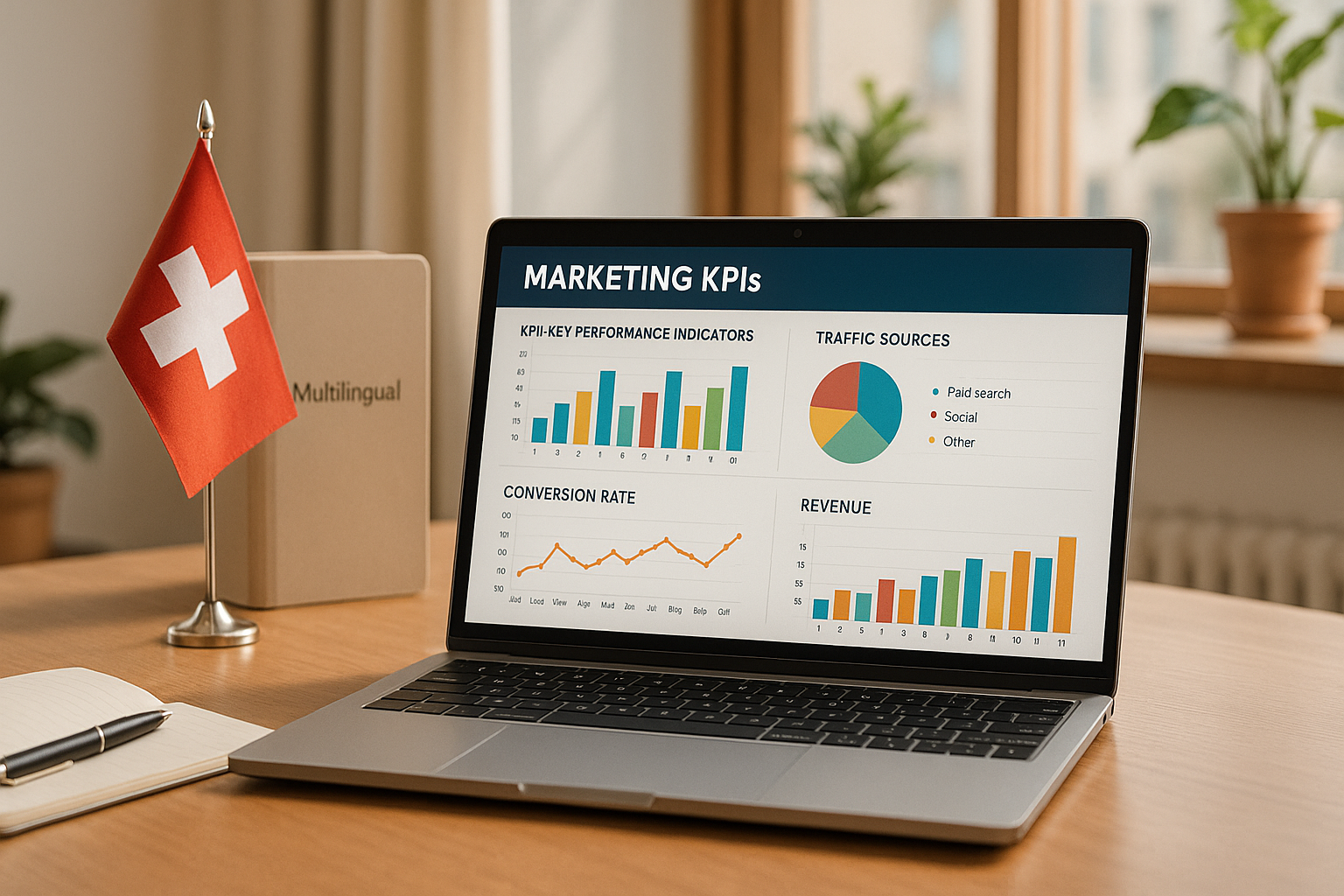
The key KPIs of digital marketing for Swiss SMEs
Key KPIs for Digital Marketing for Swiss SMEs
SMEs must monitor their KPIs to maximize their performance. Here are the key points to remember to improve your online performance:
- Web Traffic: Analyze unique visitors, sessions, and traffic sources (organic, paid, ads, etc.). Adapt your strategies according to linguistic regions (French-speaking Switzerland, German-speaking, Italian).
- Conversion Rate: Measure concrete actions (purchases, sign-ups). Optimize your pages, A/B tests, and calls to action to increase your results.
- Customer Acquisition Cost (CAC): Calculate how much you spend for each new customer. Consider currency fluctuations and local specificities.
- Return on Investment (ROI): Compare your generated revenue to marketing costs. Bilingual campaigns can expand your reach.
- SEO: Track your positions on specific keywords for each region and language. Optimize your content for French and German.
Summary Table of KPIs
| KPI | Main Objective | How to Track It? |
|---|---|---|
| Web Traffic | Understanding visitor origins | Google Analytics, Search Console |
| Conversion Rate | Turning visits into actions | A/B tests |
| Customer Acquisition Cost | Reducing expenses per customer | Analysis of advertising campaigns |
| ROI | Measuring profitability | Generated revenue vs marketing costs |
| Local and Bilingual SEO | Improving regional visibility | Keyword tracking and hreflang tags |
Tip: Use tools like Google Analytics and Meta Business Suite to track your performance and adjust your strategies in real-time. Consider Swiss specifics, such as linguistic and cultural differences, to maximize your results.
How to Use KPIs in Your Marketing Strategy: DEFINITION and EXAMPLES
Key KPIs for Digital Marketing for Swiss SMEs
For Swiss SMEs operating in a multilingual and complex digital environment, choosing the right performance indicators is crucial to maximize the impact of their digital investments. These metrics help evaluate campaign effectiveness and adjust strategies in real-time.
Web Traffic Metrics
Web traffic is the foundation of any online performance analysis. Sessions indicate how many times your site has been visited, while unique users show how many distinct individuals have viewed your pages. This distinction is essential to determine if your audience is loyal or if you are constantly attracting new visitors.
Traffic sources allow you to know where your visitors come from: organic search, paid ads, social networks, or direct access. For businesses based in Geneva or elsewhere in Switzerland, it is useful to analyze this data based on linguistic regions to understand which channels work best in French-speaking Switzerland compared to German-speaking Switzerland.
In a multilingual country like Switzerland, specific tracking is essential. Online habits vary by linguistic regions, and these differences are reflected in the results of .
Mobile-friendliness is also crucial, as more and more Swiss people use their smartphones to browse the internet. This requires mobile-friendly designs to ensure optimal visibility.
Conversion Rate
The conversion rate measures the proportion of visitors who take a specific action, such as a purchase, newsletter sign-up, or quote request. It is a key indicator for turning traffic into concrete results.
In email marketing, conversion rates typically range between 2% and 5%, depending on the sector and type of email sent. Simple optimizations, such as integrating social media connections, can significantly increase these rates.
To improve your conversions, several strategies are effective:
- Optimize site loading speed and simplify navigation.
- Use clear and engaging calls to action.
- Conduct A/B tests to identify what works best.
- Offer incentives, such as discounts or free trials.
- Reduce obstacles by simplifying forms and displaying trust elements.
In Switzerland, where linguistic differences influence behaviors, it is essential to localize content and adapt messages to each region. What works in French-speaking Switzerland may not have the same impact in German-speaking Switzerland.
Customer Acquisition Cost (CAC)
The customer acquisition cost (CAC) represents the amount spent to acquire a new customer. It is calculated by dividing total marketing expenses by the number of new customers over a given period.
For Swiss SMEs, this calculation must consider local specificities. For example, the 9.5% increase in the Swiss franc against the dollar directly impacts international marketing expenses. Additionally, negative inflation in May, with a 0.1% decrease in the consumer price index, also influences costs.
Fluctuations in exchange rates, especially with the euro and the dollar, affect not only import costs but also the competitiveness of SMEs in foreign markets.
Return on Investment (ROI)
Marketing ROI evaluates the profitability of digital investments by comparing generated revenue to incurred costs. The formula is simple: (Generated revenue - Marketing costs) / Marketing costs × 100.
In Switzerland, it is important to consider local specifics in this calculation. For example, although bilingual campaigns require a higher budget, they often reach a wider audience, thus increasing ROI. Monitoring campaign performance in French and English is essential to optimize resource allocation.
Local SEO Rankings and Bilingual Performance
For Swiss SMEs, SEO is a crucial lever. Geolocated keywords, such as "web agency Geneva" or "Lausanne agency," directly influence visibility in local search results.
In a bilingual context, it is crucial to separately track positions on keywords in French and English. Hreflang tags, content localization, and adaptation to regional specificities play a key role in these rankings.
For example, a company based in Geneva should monitor its positions on queries including specific geographical terms. A well-thought-out SEO strategy allows you to meet the varied expectations of cantons and linguistic regions.
Analysis of bilingual performance can reveal significant differences. An SME may excel in French but have average results in English, or vice versa. This granular analysis allows for targeted adjustments.
| Linguistic Region | Daily TV Time | Daily Radio Time | Share of Foreign Channels |
|---|---|---|---|
| German-speaking Switzerland | 104 minutes | 85 minutes | 58% |
| French-speaking Switzerland | 123 minutes | 64 minutes | 69% |
| Italian-speaking Switzerland | 146 minutes | 85 minutes | 66% |
Tools and Methods to Track KPIs
To optimize your campaigns and refine your analyses, it is essential to equip yourself with the right tools. Swiss SMEs should prioritize solutions tailored to the local market, taking into account multilingualism and regional specificities. These tools allow for effective tracking of key indicators such as web traffic, conversions, customer acquisition cost (CAC), return on investment (ROI), and multilingual SEO.
Google Analytics and Google Search Console
Google Analytics and Google Search Console are two essential tools for analyzing the performance of your website. Together, they provide a comprehensive view: Google Analytics analyzes visitor behavior, while Google Search Console focuses on search engine visibility.
“Using Search Console and Google Analytics together can give you a more comprehensive picture of how your audience discovers and experiences your website, which can help you make more informed decisions as you work on your site's SEO.” - Google Search Central
With Google Analytics, monitor essential data such as page views, new visits, bounce rate, and demographic characteristics. For a local approach, configure geographic segments to distinguish your performance in French-speaking Switzerland, German-speaking Switzerland, and with international visitors.
Google Search Console provides valuable insights on impressions, clicks, average position, and click-through rate (CTR). These data are crucial for optimizing your local SEO. By linking Google Analytics and Google Search Console, you get a comprehensive view of your keywords and identify queries that drive the most traffic.
To meet the needs of a bilingual audience, create separate segments and adjust content based on linguistic preferences detected via Google Search Console.
These web tools are complemented by additional analyses on social networks.
Social Media Analytics
Social networks have their own analytics tools, such as LinkedIn Analytics and Meta Business Suite (for Facebook and Instagram), providing real-time data and specific indicators.
LinkedIn Analytics is particularly useful for B2B companies, a key segment for many Swiss SMEs. Meta Business Suite, on the other hand, centralizes data for Facebook and Instagram, ideal for reaching a wider audience. These tools also allow you to compare the performance of content published in French and English, often revealing significant differences in engagement based on language.
For in-depth analysis, regularly export data to spreadsheets or centralized reporting tools. This facilitates comparison between platforms and helps identify long-term trends.
However, the Swiss market requires specific adjustments to maximize the effectiveness of these tools.
Tools and Practices Specific to Switzerland
The Swiss context, with its linguistic and regional specificities, requires precise adjustments in the choice and configuration of tools. For example, configure UTF-8 encoding to ensure correct display of special characters. Also, adapt number, date, and currency formats to avoid misinterpretations.
For companies active in multiple cantons, centralize display chains and establish a clear process for translators. This organization ensures consistent monitoring of performance in all languages.
However, gaps remain in KPI tracking. A study reveals that 39% of marketing indicators still focus on superficial metrics, such as impressions or clicks, rather than concrete business results. Even more alarming, 34.2% of marketers admit that their company rarely, if ever, measures the return on investment of its marketing expenses.
These figures underscore the importance of choosing tools capable of linking digital metrics to business objectives. Opt for solutions offering customizable dashboards and automated reports combining web data, social networks, and financial results.
Tool integration is also essential to obtain an overview. For example, connecting Google Search Console to platforms like Catchr.io can simplify data analysis and improve strategic decision-making.
How to Analyze and Improve Your KPIs
Turning data into concrete actions is the key to KPI analysis. It's not just about tracking numbers but adopting a structured approach to identify trends, understand gaps, and adjust your strategies. For Swiss SMEs, this involves considering regional and linguistic specificities that influence performance.
Setting Benchmarks and Interpreting Results
Start by establishing strong benchmarks based on your historical data and industry benchmarks. Analyze your recent statistics on your website, email campaigns, and social networks. These data will serve as a basis for measuring your progress.
If you are new to digital advertising, refer to benchmarks in your industry. For example, in Switzerland, the average conversion rate for e-commerce ranges between 2% and 4%, although these figures vary depending on your niche and audience.
The cost per acquisition (CPA) is a key indicator to assess the profitability of your campaigns. In the Swiss context, it is useful to separately analyze the performance of French-speaking and German-speaking audiences, as their behaviors may differ.
To set clear objectives, apply the SMART method. This will help you define specific, measurable, achievable, realistic, and timely KPIs. Regularly reassess your indicators to stay in line with market developments.
Once your benchmarks are established, move on to A/B tests to refine your strategies.
A/B Tests and Optimizations
A/B tests are essential for improving your digital performance. They allow you to compare two versions of an element (such as a landing page, ad, or email) to determine which generates the best results. To maximize their impact, test elements such as headlines, button colors, form placements, or content length, while considering the linguistic preferences of different Swiss regions.
Simplify the purchasing process to reduce cart abandonment. This includes streamlining the checkout steps, diversifying payment options, and optimizing your site for mobile devices, as many purchases are now made via smartphones.
Also, refine your audience segmentation based on criteria such as age, interests, or behaviors. Use retargeting campaigns to convert visitors who have shown interest but not completed a purchase. Regularly monitor performance and adjust your campaigns to maximize their effectiveness.
Aligning KPIs with Business Objectives
Once your actions are adjusted and tested, ensure that your KPIs accurately reflect your business objectives. Avoid focusing on superficial metrics and prioritize indicators such as cost per lead, conversion rates, or customer acquisition cost versus customer value.
“These KPIs are more than just numbers; they are a realistic reflection of your marketing performance, providing you with the necessary insights to refine your strategies and maximize your return on investment.” - Aleksandar Nikolski
If your goal is to increase your revenue, your KPIs should align with this ambition. This may involve increasing the number of , improving conversion rates, or increasing the average order value.
Implement loyalty programs to encourage repeat purchases and increase customer lifetime value. Personalization can also play a key role in re-engaging your customers with personalized recommendations based on their past purchases.
Finally, analyze the quality of traffic from each channel. High visitor volume from social networks is only valuable if it leads to conversions. Adjust your content or targeting strategy accordingly.
In October 2024, a study of 190 marketing companies showed that digital marketing has become an essential lever for SMEs. It promotes digital transformation, strengthens economic results, and expands market presence. By fully leveraging digital channels, you can better understand your customers and turn your KPIs into growth engines for your Swiss SME.
Specific Considerations for the Swiss Market in Tracking KPIs
The Swiss market has unique characteristics that directly influence KPI tracking. Between legal requirements, linguistic diversity, and local expectations, it is essential to adapt your tools and methods to meet the needs of this market.
Specific Formats for the Swiss Market
To ensure reliable analyses, it is essential to adhere to local formats. For example, display amounts in CHF following the Swiss style: 1'250.75 CHF for numbers and DD.MM.YYYY for dates. Use a comma as a decimal separator and an apostrophe for thousands, in accordance with the Federal Ordinance on Price Indication.
These adjustments are not just aesthetic: they enhance the credibility of your data with users. Additionally, Swiss legislation, such as the Unfair Competition Act (amended in 2022), expands opportunities beyond borders, directly influencing your conversion KPIs.